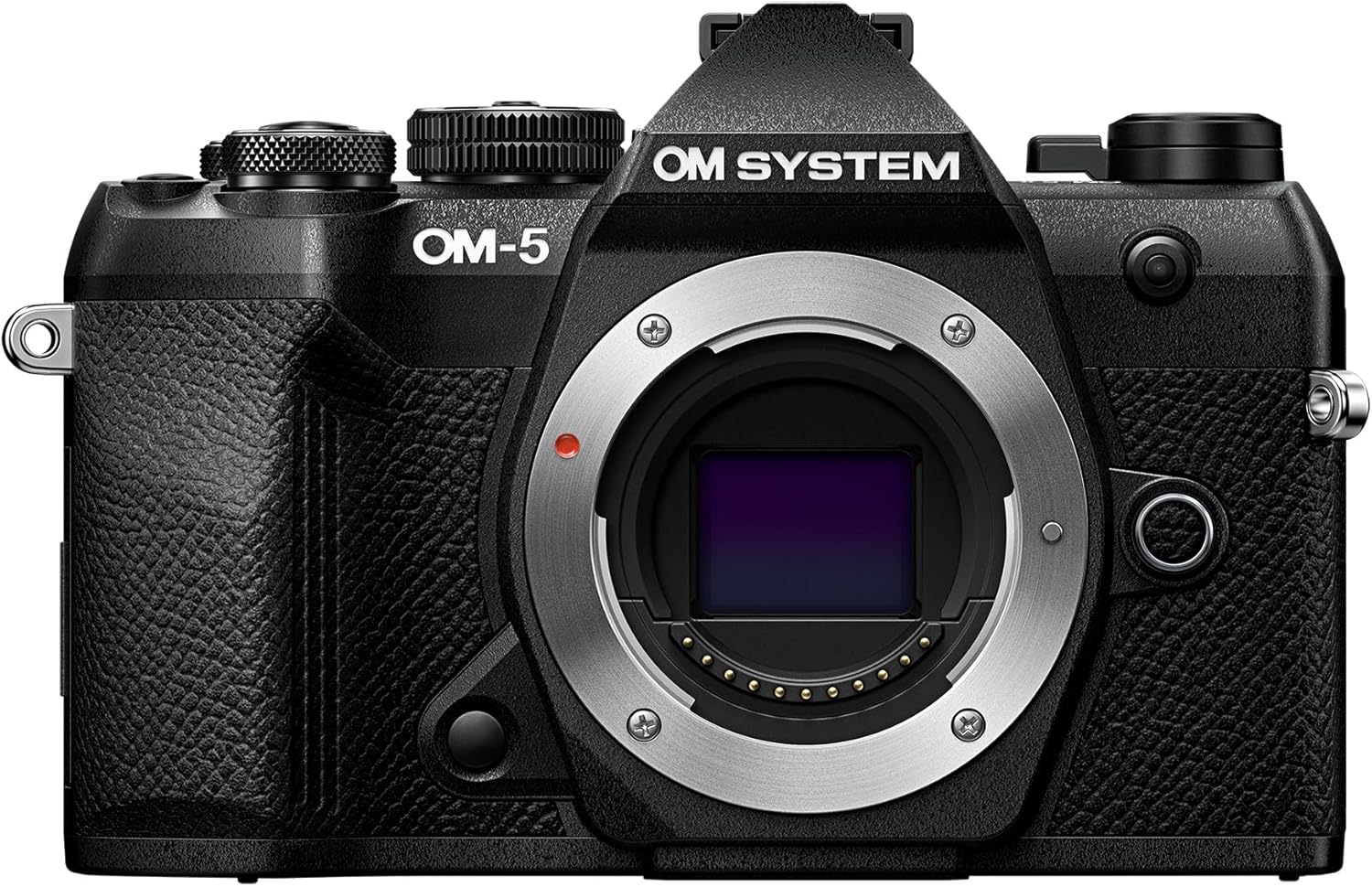
Best Weather-Sealed Mirrorless for Adventure Photography
The OM System OM-5 is IP53-rated for dust and splashproofing, operates to -10°C, and delivers class-leading 7.5-stop 5-axis IBIS — the most weather-capable mirrorless at this price, built for outdoor and adventure photography.
7.9/ 10
ClearPick Score
Decent
Image Quality
8.5
IBIS Stabilization
9.5
Weather Sealing
9.5
Video Quality
8
Value
8.5
As an Amazon Associate, ClearPick earns from qualifying purchases at no extra cost to you.
Best Weather-Sealed Mirrorless for Adventure Photography
7.5-stop IBIS is the best in-body stabilization on any camera at this price — with compatible lenses, the combined IS can exceed 8 stops. Practically, this means shooting at 1/10s handheld with sharp results that normally require a tripod at 1/100s.
IP53 weather sealing rated to -10°C is unique at this price tier — the OM-5 is designed specifically for rain, snow, dust, and cold that would damage weather-resistant cameras from Canon and Fujifilm at similar prices.
Computational photography modes are genuinely useful: Live ND filter simulates 2–9 stop neutral density in-camera without a physical filter; Handheld Hi-Res produces 80MP images from 8 merged shots; Live Composite builds long-exposure star trails without clipping highlights.
366g body only is exceptionally compact for a weather-sealed mirrorless — lighter than Canon R10 or Nikon Z50 II despite significantly more capable sealing.
⚠️ Worth Knowing
Micro Four Thirds sensor is physically smaller than APS-C — the 2x crop factor and smaller sensor area produce more image noise at ISO 3200+ compared to APS-C competitors. For daylight shooting this is irrelevant; for low-light action it matters.
MFT system is shrinking — Panasonic and OM System are the two remaining major MFT camera makers. The lens ecosystem remains excellent (wide third-party support, exceptional Olympus/OM System glass) but the system has fewer new bodies being released than Sony or Canon.
4K video quality is competitive but not class-leading — the X-S20 and Sony ZV-E10 II produce better 4K footage due to larger sensors and more advanced video processing.
Body-only purchase — add-on cost of lenses to unlock the full 8+ stop IBIS advantage. The OM-5 pairs best with OM System's own optically-stabilized lenses.
What Real Buyers Are Saying
What buyers love
“"I shot in a rainstorm in Iceland and the camera didn't miss a beat. I would never trust my old camera in those conditions."”
Source: Reddit (r/travel)Collected in an earlier pass; not linked to a source thread.
“"The IBIS is genuinely miraculous. I'm getting sharp handheld shots at 1/8s in dim light that used to require a tripod."”
Source: Amazon.ca reviewerCollected in an earlier pass; not linked to a source thread.
“"Live ND is the feature I didn't know I needed. Long-exposure waterfalls without carrying a filter kit — incredible."”
Source: Reddit (r/photography)Collected in an earlier pass; not linked to a source thread.
Common complaints
MFT sensor shows more noise at…
MFT sensor shows more noise at high ISOs than APS-C competitors — at ISO 6400 and above, the smaller 4/3 sensor area produces noisier images than the Canon R10 or Nikon Z50 II.
Source: DPReviewCollected in an earlier pass; not linked to a source thread.
Micro Four Thirds system shrinking over…
Micro Four Thirds system shrinking over time — with Olympus exiting the camera business and Panasonic releasing fewer MFT bodies, the long-term ecosystem viability is a legitimate question for buyers.
Source: Reddit (r/mirrorless)Collected in an earlier pass; not linked to a source thread.
Body-only — lenses required for full…
Body-only — lenses required for full IBIS benefit add significant cost, as the maximum stabilization advantage requires pairing with OM System's optically-stabilized glass.
Source: Amazon.ca reviewerCollected in an earlier pass; not linked to a source thread.
ClearPick Verdict
The OM-5 is the best camera for outdoor and adventure photographers who prioritize weather sealing and stabilization over sensor size. IP53 sealing to -10°C, 7.5-stop IBIS, and computational photography modes make it uniquely suited to landscape, wildlife, and travel photography in harsh conditions. If low-light indoor shooting or video quality are priorities, APS-C alternatives are better choices.